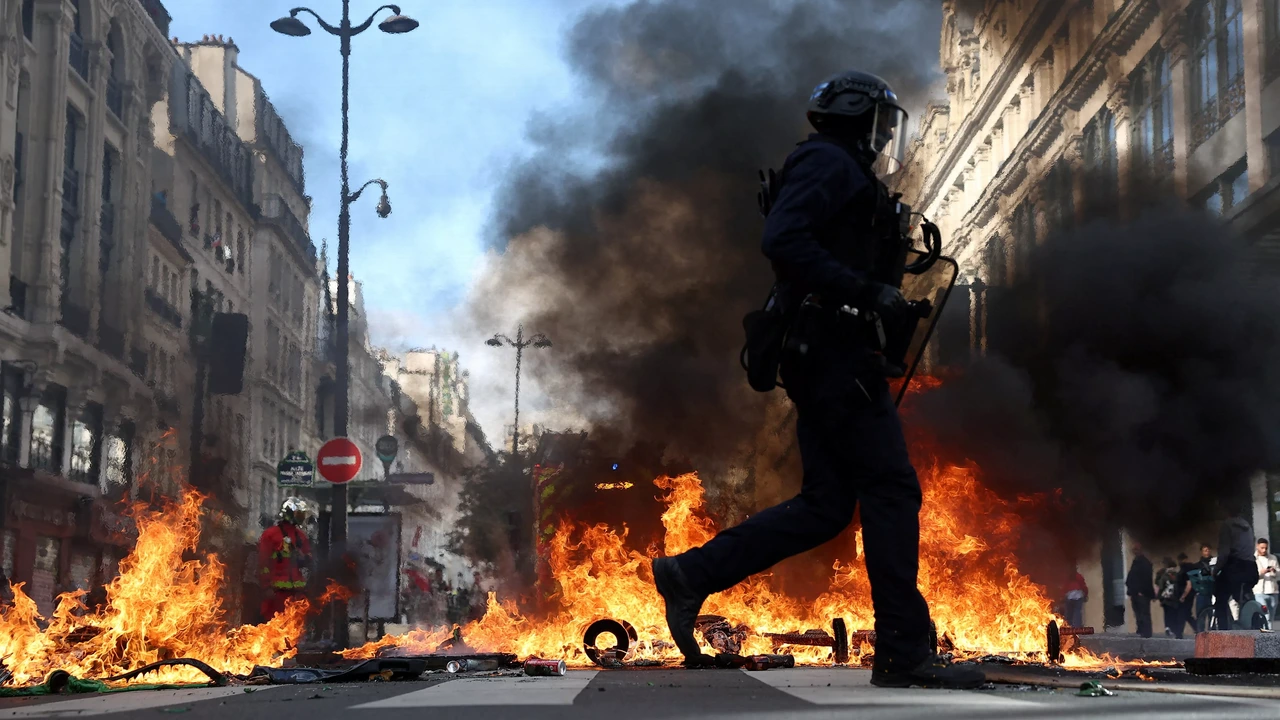
Protests across France against the rising cost of living escalated into unrest on Saturday, with police in Paris deploying tear gas and a water cannon and many dozens of people detained. A car was set alight in the capital, and in Marseille demonstrators forced their way into the city hall. The demonstrations follow weeks of school and student walkouts, but Saturday's crowds drew in far broader sections of society.
According to NOS, the French government had anticipated that the day's protests could spiral, and security forces were out in force. Anyone appearing to be a demonstrator was stopped and asked for identification. A ban on demonstrations was in place around the Champs-Élysées, though shopkeepers there still fixed protective boards over their storefronts as a precaution.
Why it matters
The unrest marks a widening of a protest movement that began with pupils and students and has now pulled in farmers, nurses and taxi drivers, alongside the yellow-vest movement that first emerged in 2018. The scale of the expected turnout — Le Monde reports authorities are preparing for 40,000 demonstrators in Paris and 150,000 elsewhere in the country, with the Interior Ministry bracing for hundreds of separate actions — signals that discontent over household costs has spread well beyond any single group. With a heavy police presence and a government already on alert, the day's events will be read as a test of how France handles a broad-based, multi-sector challenge over purchasing power.
Arrests and damage in the capital and the south
By around midday, roughly one hundred people had been arrested in Paris, French media reported on the basis of police figures. Most of the detentions were for carrying banned weapons or for wearing protective gear such as safety masks and goggles intended as a defence against tear gas.
In Marseille, intruders who entered the city hall wrote an anarchist slogan on a wall, smashed televisions and threw a bust of Marianne — the national symbol of the French Republic — to the floor, according to the French broadcaster BFMTV. Mayor Payan responded with anger, calling it unacceptable to use protests of this kind as cover for breaking in, committing vandalism and destroying a national symbol. He added that the damage to the building was limited.
The windows of a police station in Marseille were also broken and smoke bombs were thrown inside, the newspaper Le Figaro reported. No injuries were said to have occurred there.
A movement rooted in household bills
The yellow-vest movement, known in France as les gilets jaunes, began in 2018 out of frustration at a planned rise in fuel prices and grew into a wider backlash against the cost of living and income inequality. For months, participants took to the streets every weekend, and the demonstrations were marked by considerable violence. The movement was later echoed in Belgium and the Netherlands.
NOS correspondent Saskia Houttuin spoke to Salif and Jérémy, who had travelled from outside Paris to the Place de la République for their first demonstration in yellow vests. They said supermarket prices are now about one and a half times what they were a few years ago and that this has become unmanageable. Many of those who joined Saturday's demonstrations cited similar reasons, NOS reported.
Protests spill over into Belgium
Belgium also saw demonstrations on Saturday, with pupils and students marching against cuts to education budgets. One student told the Flemish broadcaster VRT that the budget for their school had been cut sharply.
As at earlier protests, unrest broke out. In Brussels, fireworks and stones were thrown at police, who responded with tear gas and a water cannon, according to VRT. Near Brussels-South station, shared bicycles and e-scooters were set on fire, as had happened the previous week. Several people were detained, VRT reported without giving details. Demonstrators also took to the streets in Liège, where traffic was blocked at various points.
Attention now turns to whether the movement sustains its momentum beyond Saturday, and to how the government and police respond if the multi-sector demonstrations continue.